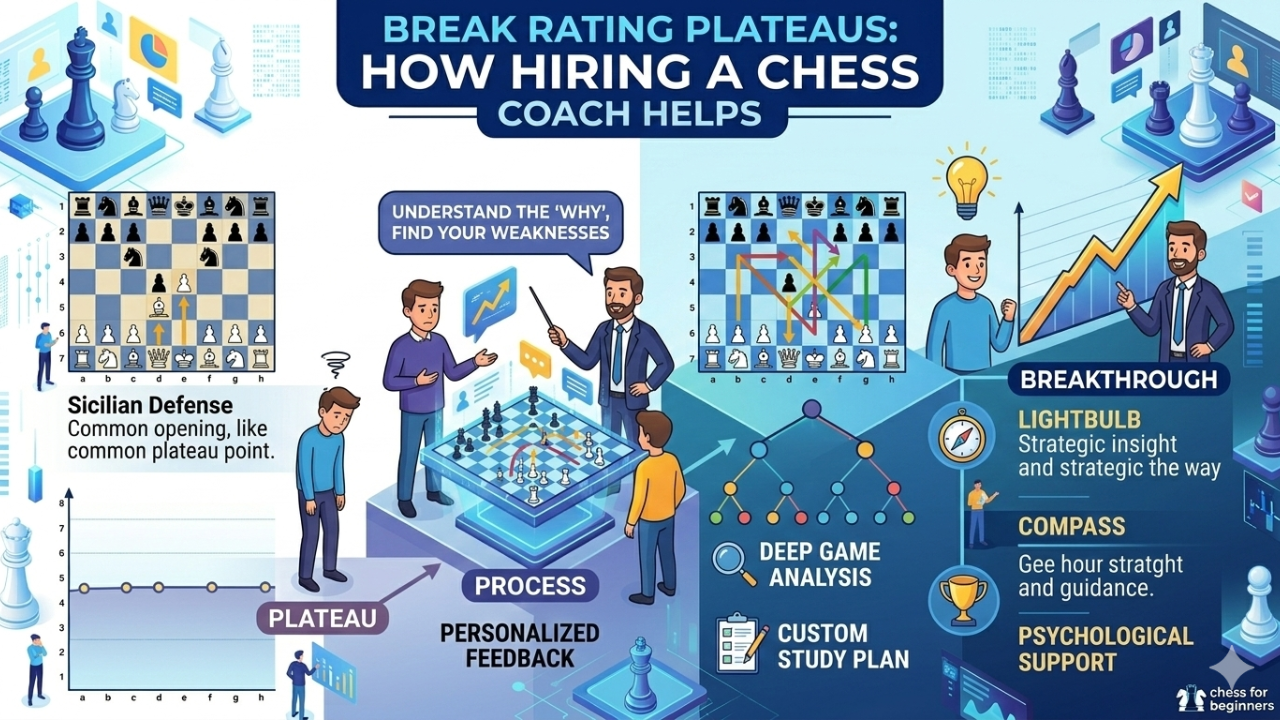
Every chess player eventually experiences a rating plateau. You study openings, solve puzzles, watch instructional videos, and play many games, yet your rating refuses to move. Weeks or even months pass with little progress. This stage can feel discouraging, especially when the effort you invest does not produce visible results.
Rating plateaus are common because improvement in chess is rarely linear. Often the problem is not lack of effort but lack of direction. Many players repeat the same mistakes without realizing it. This is where hiring a chess coach can make a major difference.
A good coach helps identify the real obstacles behind your stagnation and provides a clear path forward.
From a human perspective, one of the biggest benefits of working with a chess coach is accountability. When you train alone, it is easy to skip study sessions or drift between different topics without consistency. A coach introduces structure and expectations.
Knowing that your games will be reviewed encourages you to concentrate more during play. It also motivates you to study regularly because someone is guiding your progress. This simple psychological shift often leads to more disciplined training habits.
Motivation also increases when improvement feels guided rather than random.
Most players stuck at a rating plateau share a similar problem. They make the same types of mistakes repeatedly. Perhaps they blunder tactics under pressure, misjudge exchanges, or struggle with endgames.
When studying alone, these patterns are hard to notice. A chess coach analyzes your games objectively and identifies recurring errors. Once these patterns are clear, training can focus directly on correcting them.
Instead of studying everything, you begin studying what actually matters for your improvement.
Many players study chess in a scattered way. One day they review openings, the next day they solve puzzles, and later they watch random videos. While each activity can be useful, without structure the learning process becomes inefficient.
A chess coach creates a training plan based on your current strength and goals. This plan balances key areas such as openings, middlegame understanding, tactics, and endgames.
Structured training ensures that each skill develops gradually and supports the others. Over time, this consistency produces steady rating progress.
A major reason players hit rating plateaus is not knowledge but decision-making. They know many chess ideas but struggle to apply them during actual games.
A coach works on your thinking process. Instead of moving impulsively, you learn to evaluate positions, calculate variations, and identify candidate moves. These habits create a reliable decision-making system.
Once this thinking process becomes natural, your moves become more accurate even in complex positions.
Openings are often misunderstood by club players. Many try to memorize long variations that rarely appear in their games. This leads to confusion when opponents deviate early.
A chess coach helps build a practical opening repertoire suited to your style. Instead of memorizing endless lines, you focus on understanding plans, pawn structures, and typical piece placements.
This approach makes openings easier to handle and allows you to enter the middlegame with confidence.
Endgames are one of the most common weaknesses among improving players. Many games reach simplified positions where accurate technique is required, yet players lack confidence in this phase.
A coach introduces essential endgame principles and teaches practical methods to convert advantages or defend difficult positions. Once endgames become more comfortable, many close games start turning into wins.
Improvement in this phase alone can significantly raise your rating.
Chess improvement includes setbacks. Losses, blunders, and bad tournaments can shake confidence. Players studying alone often become frustrated or doubt their progress.
A coach provides perspective during these moments. They help you analyze losses constructively and turn them into learning opportunities. This guidance prevents emotional reactions from disrupting long-term improvement.
Confidence grows when mistakes are treated as information rather than failure.
General chess advice can only go so far. Each player has unique strengths and weaknesses. Personalized feedback accelerates improvement by focusing exactly where it is needed.
A coach observes how you calculate, evaluate positions, and manage time during games. Small adjustments to these habits can produce large improvements in performance.
This targeted approach saves time and prevents wasted effort.
Hiring a chess coach is not simply about learning more chess knowledge. It is about learning how to improve efficiently. The guidance, structure, and feedback a coach provides transform the training process.
From a human perspective, a coach builds discipline and confidence.
From a basic learning perspective, a coach corrects repeated mistakes.
From a chess perspective, a coach refines your thinking process and strategic understanding.
Together, these benefits help players break through rating plateaus and continue progressing toward stronger play.
chessbrainz
Mar 05,2026
 0
0
 6
6
chessbrainz
Mar 02,2026
0
72

chessbrainz
Feb 26,2026
0
44
chessbrainz
Feb 25,2026
0
29
06
072
044
029
.png)