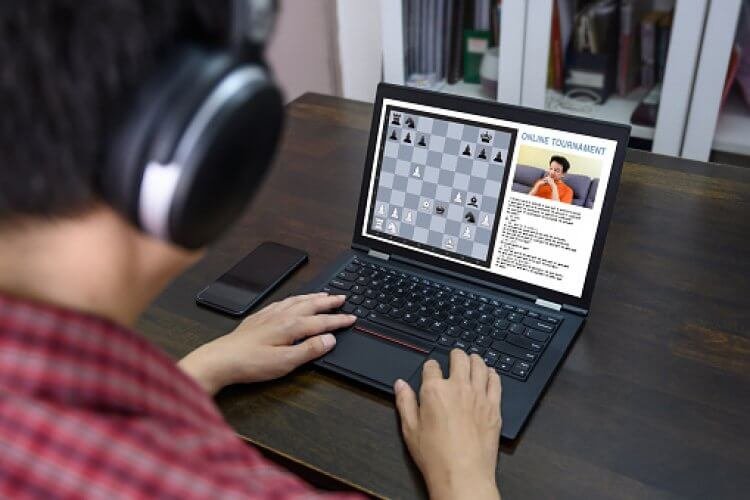
Many beginners imagine that strong players train by memorizing endless openings or playing blitz all day. In reality, a 2000+ rated player’s training is defined less by what they study and more by how they study. Strong players focus on clarity, feedback, and deliberate effort. They are not trying to know everything; they are trying to reduce mistakes and make better decisions move by move. This approach is accessible even to beginners because it is based on habits and structure, not advanced knowledge.
Training like a strong player means accepting that improvement is not about quick tricks. It is about building a system that steadily improves your thinking, broad vision, and decision-making. A beginner who trains with this mindset will progress far more efficiently than someone who jumps randomly between puzzles, videos, and games.
One of the biggest differences between beginners and strong players is how they treat their games. Beginners often play many games with little reflection. A 2000+ player treats each game as training material. Even if you play fewer games, you can gain more by thinking deeply during them and reviewing them afterward.
As a beginner, you should slow down. Choose longer time controls whenever possible and force yourself to calculate before moving. Ask simple but critical questions: what is my opponent threatening, what is the worst piece in my position, and what changes after my move. This habit trains your mind to evaluate positions, which is far more valuable than playing dozens of fast games without focus.
Strong players improve by confronting their weaknesses directly. After a game, they do not rush to an engine immediately. They try to understand where their thinking went wrong. Was the mistake tactical, positional, or psychological? Did they miss a threat, misjudge a trade, or play too fast?
Beginners can adopt this habit easily. After every serious game, replay it without an engine and write down where you felt unsure or confused. This process builds self-awareness, which is a critical skill at higher levels. Engines are useful, but only after you have tried to explain the game in your own words. This is how you train your chess intuition instead of outsourcing your thinking.
Tactics are essential, but strong players do not solve puzzles mindlessly. They treat each puzzle as a calculation exercise. They calculate variations carefully and only play a move once they are convinced it works. This is very different from guessing or relying on pattern recognition alone.
As a beginner, you should solve fewer puzzles but with full concentration. Sit with the position and calculate until you can clearly see the idea. Even if you get it wrong, the effort itself is training your calculation muscles. Over time, this approach builds accuracy and confidence, which are far more important than solving hundreds of easy puzzles quickly.
A 2000+ player does not try to surprise opponents with tricks in the opening. They aim for positions they understand well. Beginners often make the mistake of studying too many openings without understanding the underlying ideas.
Training like a strong player means choosing simple, principled openings and sticking to them. Learn where your pieces belong, what pawn breaks you are aiming for, and which typical mistakes to avoid. This creates familiarity, allowing you to focus on middlegame decisions instead of trying to remember moves. Strong players value understanding over novelty, and beginners should do the same.
Many beginners postpone endgame study, assuming it is only relevant at high levels. In reality, strong players know that endgames teach precision, patience, and calculation. Even basic endgames improve your overall chess understanding.
You do not need advanced theory. Start with simple king and pawn endings and basic rook endings. Focus on understanding ideas like activity, opposition, and passed pawns. This type of study sharpens your sense of evaluation and helps you play the middlegame with clearer goals, knowing which positions are favorable to trade into.
A key reason 2000+ players are consistent is emotional control. They do not panic after a mistake or lose focus after a loss. Beginners often underestimate how much psychology affects results.
Training like a strong player means accepting losses as feedback, not failure. It also means managing energy and avoiding burnout. Short, focused training sessions are more effective than long, unfocused ones. Developing patience and resilience early will protect you from frustration and help you enjoy the improvement process.
Strong players follow routines they can maintain over time. They do not chase motivation; they rely on structure. Even as a beginner, you can do the same. A routine that includes thoughtful games, post-game analysis, tactical work, and light study is enough to make steady progress.
The key is consistency. Training like a 2000+ player is not about doing everything at once. It is about doing the right things repeatedly, with attention and honesty. If you build these habits early, your rating will eventually reflect the quality of your training.
The biggest advantage of training like a strong player is that it scales. The same habits that take a beginner from 800 to 1200 are the habits that take an intermediate player to 2000 and beyond. You are not copying advanced knowledge; you are copying a thinking process.
By focusing on quality, reflection, and understanding, you avoid common traps that slow improvement. You also build confidence because you understand why you are improving, not just that you are winning more games. This is the foundation of real chess growth.
Training like a 2000+-rated chess player is not about being advanced. It is about being intentional. If you adopt these principles early, you will not just improve faster; you will improve correctly.
 Previous ArticleThe Truth About Chess Study Burnout and How to Prevent It Next ArticleWhy Pattern Recognition in Chess Matters More Than Memorising Openings
chessbrainz
Mar 09,2026
 0
0
 23
23

chessbrainz
Mar 09,2026
0
41
chessbrainz
Mar 09,2026
0
26

chessbrainz
Mar 06,2026
0
86
023
041
026
086
023
026
086 00
00
.png)