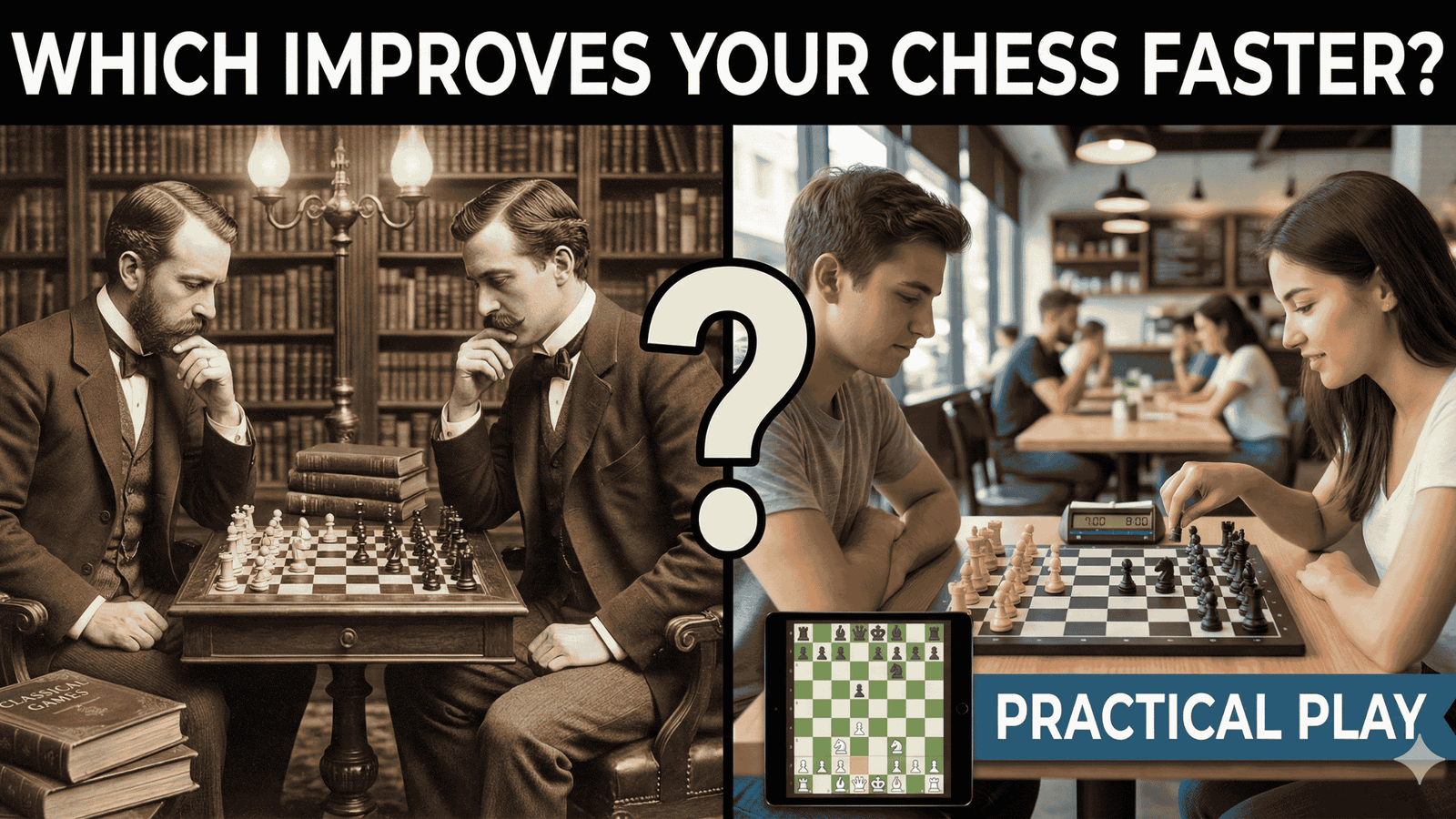
Every chess player eventually faces this question: should you study classical games played by legends or focus more on practical play to improve faster? Many players choose one and ignore the other; this is where progress slows.
Studying classical games helps you understand why strong moves are played. You learn correct development, pawn structures, long-term planning, and how great players slowly build and convert advantages. This improves positional understanding and teaches structured thinking.
Practical play builds real match skills. Playing games regularly trains you to handle time pressure, recover from mistakes, defend difficult positions, and exploit opponent errors. It sharpens instincts and decision-making.
The fastest improvement comes from combining both. Classical study builds understanding, while practical play turns knowledge into results. Studying alone makes your chess theoretical. Playing alone repeats mistakes.
A simple routine works best: study a few classical games each week, play consistently, and review your games honestly.
If you want structured guidance and faster progress, you can book a free demo chess class and learn how to balance study and play correctly.
— Kunal Gupta
 Previous ArticleThe Hidden Academic Edge: Why Top Students Often Learn Chess Next ArticleOpenings or Endgames: Which Should You Really Master First?
chessbrainz
Mar 09,2026
 0
0
 115
115

chessbrainz
Mar 09,2026
0
125
chessbrainz
Mar 09,2026
0
148

chessbrainz
Mar 06,2026
0
263
0115
0125
0148
0263
0115
0125
0148
0263
.png)